MUSUBI DOJO

KAMPSPORT OCH SJÄLVFÖRSVAR

Nyheter från bloggen


Aikido


aikido

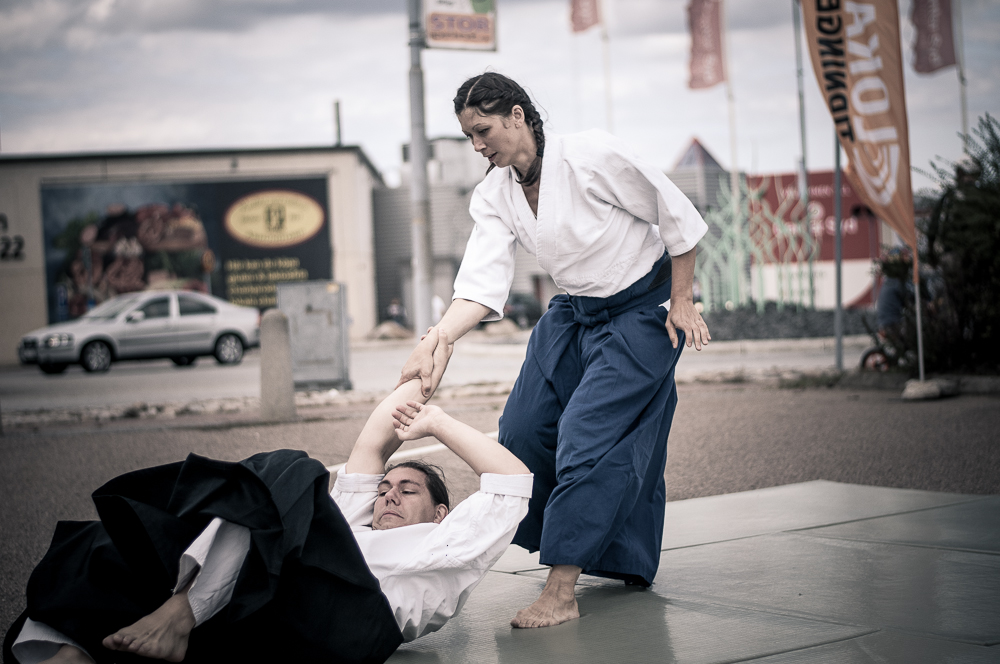
Aikido är en Japansk kampkonst som grundades 1920 av Morihei Ueshiba.

Under sin livstid tränade Morihei olika samurai stilar som han sen förde samman till dagens Aikido, ett system byggt för att ta kontroll över flera attackerare med kontroll och harmoni.Att Kontrollera aggression utan att tillföra skada är en konst och fredlighet.Aikido blev känt som en Kampkonst 1941 och har sen dess spridit sig över hela världen.Aikidons tekniker har ett huvudsyfte att utnyttja motståndarens rörelse och attack och förstärka rörelsen till sin egen fördel.Det går utmärkt att träna Aikido oavsett ålder kvinna eller man då man själv bestämmer vilket tempo respektive hur hårt man vi träna så fokus och kontroll blir en del av träningen.För att höja skärpan och fokus ingår det träning med träsvärd (bokken) trä stav (jo) tekniker mot kniv man tränar vapen mot vapen och vapen mot tom hand (utan vapen)Ni är välkomma att komma och prova!


Aikidophylosophy, art, sport

  • History and the founder of Aikido

Aikidois one of the youngest martial arts but it is based on the older system called  aikidoAikijujutsu.

Aikijujutsu was founded during the Kamakura era (11816 – 1333) by Minamoto Yoshimitsu, an offspring of a powerful family in Japan at that time. The martial art was passed from father to son in Minamoto family, and then in Takeda family,  improved throughout the time.

After seven generations Morihei Ueshiba got to learn it. He modified the old techniques to create modern Aikido. Morihei (1883-1969) was a weak and sickly boy, and already when being young, he started to study martial arts in order to strengthen his body and spirit. He trained karate do, kendo, jujutsu, naginata and travelled a lot in Japan to learn from the best masters.

He improved and mastered his knowledge in Daito school headed by Takeda. Techniques taught by master Takeda included a lot of Aikijujutsu movements. After 20 years of hard training, Morihei became the most famous specialist in martial arts at that time. Ueshiba defeated all his opponents, but no one could defeat him. His body became strong as steel, but spirit was still restless. In order to solve the inner conflict, he started to study philosophy and religion deeper.

In the end, he found a path, the Way of harmony and love. Combining martial arts and his views he created a new system. In 1925, Morihei Ueshiba opened his own school, although the number of disciples was limited.

Morihei hesitated to open his teaching to a wider public. He started to teach it only after the end of the Second World War, in 1948. He thought that then it was time to give it to a defeated, lost nation in order to survive and find a true path to peace with themselves. In the middle of 50s, he, together with his son Kisshomaru and one of Morihei’s first students, Koichi Tohei, made a tour to USA and Europe. In Europe, starting with France, he spread aikido by sending sensei Mochizuki (1951) and Tadashi Abe (1952.)

The main school in Japan is Aikikai with its headquarter in Hombu Dojo, headed by Ueshiba family. However, there are other styles such as yoshinkan, yoseikan etc. which do not belong to Aikikai.


  • What is aikido?

AI, the first sign, means harmony, connection, but its closest interpretation which comes from its literary meaning is conjunction. The second sign, KI, means soul, spirit, energy. DO, the third sign, means a path or a method. AIKIDO means a path to connect with the spirit. Aikido is a complicated martial art which allows you to improve your body, spirit and mind. It has a number of techniques to defend from different weapons and, at the same time, it is one of the most ethical and “soft” martial arts of all. Aikido is an excellent system for physical development. As a sport, it is suitable for people of any age or gender.

Then, what actually differs Aikido from other martial arts? There are a great number of conflicts in the world, and new ones are constantly coming up. Nations conflict with each other, human race conflicts with the Nature. Everyone wants peace but most of us live in a permanent conflict with ourselves and the environment, ready for new aggravations all the time.

Some people give up and lose, others keep on training, physically and mentally, to be able to win. Victory is an ultimate goal in most martial arts and sports, but on the way to it, a person plants a seed of evil in a fertile soil. In all sports, a master, when being attacked, answers with a powerful strike or a cast which may result in a heavy injury. Aggression is met with aggression, and although you strive for defeating your opponent and winning (which is also only a question of time; people grew older, and physically weaker), both lose in the end. The victory amuses the winner’s ego, but brings no happiness to either him or the defeated.

It means that any victory is meaningless. Then, what should people do if fight has become their lives, and victory the main goal? Aikido answers this question. This martial art is based on the laws of Nature. By following these laws, we can avoid fighting, bring justice without harming anyone and save your own or others’ lives without killing those who attempted to harm us. Aikido master, following the principle of non-resistance, does not counterattack. He makes the attacker give up the intention to attack in a soft and balanced way.

Aikido counteracts aggression instead of an aggressor himself. An aikido master spares a man in affection, bringing him into a whirlpool which, after twirling him as a splinter, carefully brings him to a shore. And so again and again, till the attacker realizes how meaningless his idea has been and calms down. This philosophy was quite revolutionary for martial arts which used all possible means at hand to fight the evil. O’Sensei (another name of Aikido’s founder) was convinced that Aikido would help people solve their problems, resolve conflicts and live in harmony.


  • Principles of Aikido

There are no attacking techniques in Aikido. It has gripping, throws, leaving the attack line and some strikes aimed mostly at distracting an attacker. An Aikido master can read the attacker’s  manure from his initial movement and, using the attacker’s energy and direction, sets him in an uncomfortable position all the time. By doing this, he won’t allow an attack to continue, and the confrontation naturally comes to an end.

A master himself does not apply any force, and the power of the attack will turn against an attacker. The more fierce and powerful an attack is, the quicker and most powerfully it will be destroyed. This rule applies no matter what, even if an attacker and a defender have a significant difference in weight or length, or if there are several attackers. A person who has understood Aikido principles will naturally show consideration and understanding towards those who have not reached this stage.

As Aikido is not only an Art but also a great weapon, even a defensive one, you can use it only in three cases, as o’Sensei taught: when your life is threatened, when other person’s life is threatened, or when a group of people in a crowd behaves aggressively and is a danger for others. But even in these cases you should try to solve the problem peacefully.


  • What is Aikido based on?

Aikido is based on four principles:

  • Centering(hara);
  • Extending energy(ki);
  • Control;
  • Circular movements(dynamic sphere).

None of these notions can be explained separately, they complement each other. Let’s have a look at them one by one.

  1. Centering

Harain Japanese means both the stomach and the core, the geometrical center in the human body that is practically the same as the center of gravity. The point has peculiar names, such as seika no itten or seika tanden. This is the point where all vital energy to the entire body spreads from. Centering can be subjective and objective.

Subjective centering means permanent focus on the center (seika tanden.) Objective centering means your ability to unite your own center with the center of the fight (or any interaction.) When you can focus on your tanden, you can achieve concentration, prevent outer disturbing factors to interfere with your inner world, improve your physical abilities and your attitude to the world.

This focused state of mind allows Aikido masters to react adequately on the attack from the side or from the back, which cannot be seen.

Physically, centering means the ability to transit from the static (relaxed) to the dynamic (active) state. It can be compared to a spinning whipping-top, which looks almost immobile for the viewer. Such phenomenon is closely related to the ki power.

  1. Extending energy (KI)

A special type of energy called prana in Indien, chi in China or ki in Japan is something that is usually called bio energy, or hidden power. There are two kinds of kiyang (male, hard, ”positive”) and ying (female, soft, ”negative”.) This energy is present everywhere including people, but in a dispersed and non-controlled condition. You will need to unite and accumulate this energy in order to release it and extend when required in a peculiar direction and concentration.

The body in all Eastern martial arts is considered as an entity (arms and legs are extensions of the body, and the body is an extension of the mind), and any movement (strike, grip or movement) as an action of the entire body. Remember the old wisdom “Spirit controls the body”. If there is no ki, there is no Aikido. Unbending arm, an exercise when you need to bend the instructor’s arm, his muscles being relaxed but you just cannot bend the arm, is one of the most important exercises in Aikido, but it is only a half way to mastership. Unbending arm is a static manifestation of ki, but Aikido is all about dynamics.

How can we learn to accumulate, stabilize and extend the power of ki? There are different meditations, such as sitting meditation (zazen), standing meditation (standing like a tree in chigong), asanas in yogatai chi, which are made with deep abdominal breathing. It relates to focusing and concentrating energy in tanden.

In Aikido, there is a section called aiki taiso, or “aikido gymnastics”, when you do exercises from the hips, i.e. from your center, with total ki extension. It means that a push is done not by the stretched hands, but the whole body, with the sensation of ki flowing from the center thorough the arms to the goal.

  1. Control

Interaction in Aikido is always about maai. You need to control your opponent’s actions right from the start in order to establish a contact, as contact should be maintained throughout the entire technique. When you are attacked, you should be able to re-route a potentially dangerous attack to a safe direction.

This transition should be smooth and continuous, never directly against the attacking direction. Never use force against force. All direct actions will cause direct counter-actions. These reactions are inmate and are difficult to get rid of. You need to learn to spin when you are pushed (tenkan) and go in (irimi) when you are dragged; this is the main principle of non-resistance (ju.) If you use force against an attack, you will get an enemy.

  1. Circular movements (dynamic sphere).

Most movements in Aikido come in circles, spirals, half-spirals and make a”dynamic sphere” which becomes your protection. In Asia, spheres and circles are notable symbols and are memorialized in religions, philosophy such as Taoin China, the Wheel of Life in the Buddhism, a number of wheel symbols in Hinduism.

Sphere was also used in martial arts and reached its highest level of functionality in Ba-Gua. In this Chinese boxing, there are no linear movements; fighters as if copy a hawk’s flight roaring in the circle after its pray.


  • Important when training Aikido
  • One aikido technique may kill a person. Listen to and follow your instructor’s directions; do not turn training into a meaningless demonstration of power.
  • Aikido is an art where one person learns to meet several attackers at the same time. This art requires well-trained and excellently performed movements, so that you could throw attacker, no matter how many they are.
  • Train Aikido with pleasure and high spirit.
  • O’Sensei teaching is only a little part of what you will learn. How good you will be depends entirely on your efforts.
  • Training starts with soft, smooth movements, and although their intensity will increase, you are not to apply force.
  • The purpose of Aikido is to train the body, spirit and mind and become pure at heart. You are not to use Aikido for dirty purposes.


Nytt från de olika stilarna

  • Skriven av
    17 mars 2013

    Österlen kampen 16 mars

    Lördagen den 16 mars avgjordes Österlenkampen i Judo i Tomelilla sporthall. Detta är en nybörjartävling för vit och gulbälte. Musubi Dojo hade 12 st förväntansfulla Judokas som skulle tävla samt…
  • Skriven av
    04 februari 2013

    Judo Syds dag 16 mars

    Judo Syds dag 16 mars Missa inte att delta på denna dag där det kommer att bjudas på aktiviteter i Judons tecken hela dagen. Läs mer i de två dokument som är bifogade längre ner…
  • Skriven av
    28 december 2012

    Läger 4-6 januari

    Missa inte detta fina läger i Hörby. Utveckla dina tekniker och träffa människor från andra delar av kampsportsvärlden. Kolla länkarna längre ner på sidan

jNews Module


Mottag HTML?

Du är här: Home Träningsformer Aikido